
Operation
Four weeks to the first released assembly
Four weeks means marks, a bill-of-materials check, and the release of one assembly. Not the archive, and not the ERP.
The sentence lands near the end of the meeting, once the drawings are on the table. Ready in four weeks. Each person in the room hears the job they want off their desk. Design hears the whole archive. IT hears an interface. Service hears that incomplete requests stop that day. The sentence means one assembly: marks on one sheet, a check against the bill of materials, and a release. A customer can then open this assembly from the serial on the nameplate. The rest of the machine stays where it is.
Four weeks works when the sheet exists and someone can answer for it. It is no frame for twenty years of variants, and no frame for an ERP project. Hear it as either of those and week five ends with nothing released.
What happens in the four weeks
First the sheet is on the table. A current exploded view of the assembly, not the prettiest plot in the folder and not a fair revision from years ago. Current means the revision you intend to show for the serials in the trial. Someone places marks on the position numbers. Each mark belongs to a balloon, and the balloon carries the number that will stand in the request.
Then the check. Every mark a customer should hit needs a bill-of-materials line: position, part number, name, fitted quantity. Every line that should be requested on its own needs a place on the sheet. Where the two agree, the path is clear. Where a number has no line, or a line has no balloon, there is a gap. The gap is written down. It is not closed with a guessed part number to make the view look calm.
At the end stands the release. Someone who can answer for the assembly says: this sheet, for these serials, the customer may see. Until then the drawing is a working sheet. The four weeks end when this one assembly is released, not when every station is. Ready in four weeks means one released assembly, not the archive.
What the four weeks are not
They are not a plant go-live. A portal for one assembly does not change picking, invoicing, or the warehouse shift. It changes the line that arrives, and only for the parts on this sheet. Calls about other stations continue as before. That is the scope.
They are not an archive project. Stamped plots, scanned folders, old bills of materials, serials that live only in someone's head: showing all of that in four weeks would mean promising documents nobody has laid side by side yet. The four weeks lay one assembly side by side. The rest becomes a list of gaps, not a finished catalogue.
They are not an ERP project. The request leaves as email or as CSV. A person takes it over. Nothing books, nothing reserves, nothing creates a customer master. Spend the four weeks on fields, permissions, and night runs, and the sheet never gets released. Booking stays outside this period.
What you put on the table
You put down an exploded view you would call current if a good customer rang tomorrow. With it, the bill-of-materials lines for that sheet, position and part number, as inside sales says them. With those, the serials that should see this sheet, and the serials that must see another sheet if the revision changed. A machine and its neighbour from the same year are often not the same sheet.
You also decide the gaps. Not how to close each one: what may become visible, and what stays back. A position without a sure part number stays invisible. A part never supplied on its own needs no balloon, even if the plot numbers it. Screws that never appear in a request fill the four weeks and teach nothing. The part people phone about needs a number that stands in the list.
Untidy documents are no reason to push the period back. A PDF with two revisions, a list with different column names, serials from memory: that is the material of the check. The sheet becomes orderly through the release, not by waiting for a clean delivery.
What the customer does in the trial
The trial is not a presentation. Someone opens the drawing with a serial from the nameplate, taps a position, and sends a request. The request then holds serial, assembly, position, part number, name, and a quantity this person set. The quantity does not slip in from the bill of materials. The request arrives as email or CSV. A colleague on inside sales says whether they can make a job from it without calling back.
That is the test. Not whether the page looks pleasant. Not whether every screw has a circle. Whether the number the customer hits is the number your warehouse would understand. You need a serial from the set you released, and a position that stands in the bill of materials. The demo, with the fictional Muster Maschinenbau GmbH and the VFS 400, shows the same grip on an invented machine. It does not show your gaps.
The designer always finds his own number. The fitter finds it, or finds the neighbouring number, because two balloons sit too close. That difference is a result of the four weeks. It is not written into the drawing number.
When nobody orders the assembly
Four weeks on the wrong assembly teach almost nothing. Wrong means nobody asks for it. A cover rarely requested can still make a clean sheet, and you learn only that a rare sheet can be released. You do not learn whether the path carries the calls that fill the morning. The seal station, the drive, the assembly named in the note carry that answer. The quiet cover does not.
Service and design choose together. Design knows which sheet looks complete. Service knows which sheet is missing when the machine is down. A handsome sheet with no requests tests the filing. An unsettled sheet with requests tests the path. For the trial, take the second, even where the check shows more gaps. A gap-free sheet nobody needs is a quiet hour with no finding.
If the serial does not point at this sheet, do not switch in secret to an easier sheet so that Friday still gets done. Write down why it does not point there. An easier sheet saves the calendar and throws away the question of whether this assembly can carry a request.
Further scope sits in the quote
After the four weeks there is a released assembly, or a clear list of why it is not free yet. Both are a result. The quote that follows says which further assemblies take the same path, which serials are added, and what happens to the gaps. That scope can be negotiated, because you have seen it. A scope fixed before the first sheet negotiates a guess.
The second assembly is not automatically as quick. Some sheets are a repeat. Some are a knot of three revisions. The quote can tell those apart if the first pass was honest. If the first sheet was one nobody orders, the quote fills up with estimates again.
Unreleased assemblies stay invisible. The customer understands that one station still means a phone call. He does not understand a wrong position. Everything past the one released assembly is the next sentence in the quote.
By Clemens Jonathan Schmid
Related articles
All articles
Operation
The drawing stays with the manufacturer
The manufacturer keeps the drawing, the customer sees the released assembly, and hosting in Germany is a plan.
By Clemens Jonathan Schmid8 min read
Operation
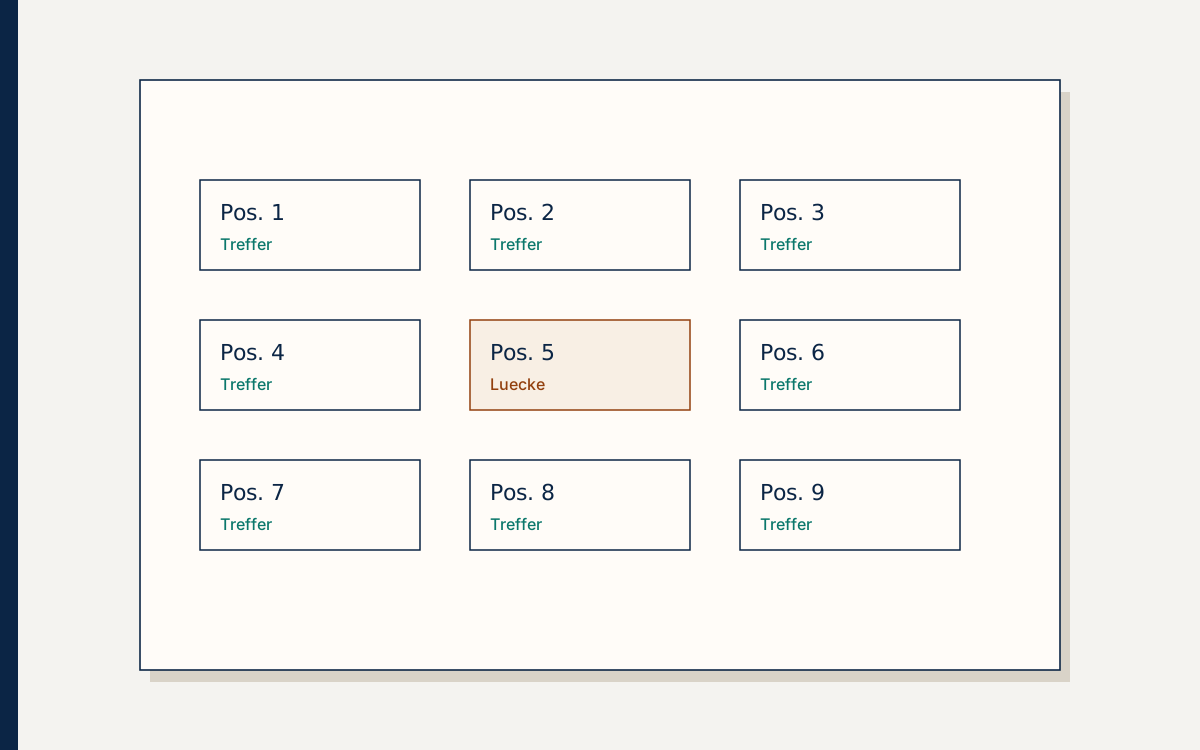
Mark the gaps in the bill of materials
Missing bill-of-materials lines and unknown numbers stay marked until a person closes them before release.
By Clemens Jonathan Schmid6 min read
Operation
One assembly is enough for the first trial
One sheet, one bill of materials, the serial numbers that belong to it. That shows whether the path holds before the whole family is documented.
By Clemens Jonathan Schmid8 min read