
Operation
The drawing stays with the manufacturer
The manufacturer keeps the drawing, the customer sees the released assembly, and hosting in Germany is a plan.
In the meeting room the folder is still closed. The customer has asked to keep the exploded drawings "on their side", on a maintenance drive, so their people need not call. Your own IT asks which server that would sit on, and which certificate to send the customer's purchasing. Someone says to upload the archive, then it will be searchable. The folder stays closed, and that is the right reflex. Searchable is not the same as released. An archive the customer can search shows drafts, old revisions, and neighboring assemblies never meant for their series.
The drawing stays with the manufacturer. What the customer sees is the assembly you have released for their series. Not the folder. Not the folder of the last twenty years.
What the customer should see
The customer stands at the machine, reads the serial number off the plate, and opens the exploded drawing released for that machine. They see the assemblies you have made visible for this series. They tap a mark. The inquiry carries series, assembly, position, part number, designation, and the quantity they set. If a number is superseded, they see the note on the successor. The old number stays findable. That view can carry an ordering path.
They do not see last week's draft. They do not see the neighboring series just because its sheet lies in the same folder. They do not see every file a designer once stored for this type. Those files stay with you, as working status or because they belong to another machine. An assembly becomes visible when someone releases it, for these series, in this revision. Before that it is a worksheet. After that it is a statement.
That boundary is the real content of the release, not an extra caution beside the upload. Uploading stores a file. Releasing says this file, as it stands, may be shown to the customer of this series. Mix the two and every import looks like a statement. An import is preparation. The manufacturer makes the statement.
The archive is not a catalog
A complete archive feels like good service. The customer could search alone, maintenance would be independent, the calls would fall. In practice they then search sheets that contradict one another. Two revisions on one page, a footnote nobody reads, a bill of materials that belongs to the other sheet. They tap a position their machine does not have, and the inquiry looks complete. Complete, and wrong.
The catalog is not the archive. It is the set of released assemblies. It grows when you have checked the next assembly and released it, not when a folder is copied. Gaps stay marked until a person closes them. You do not release an assembly with an open gap, even if the folder already holds it. The customer understands a missing assembly. They do not understand a wrong position.
"Ready to use in four weeks" means one released assembly, not the archive of a product family. Which assemblies and series come next is set out in the quotation. The files you release from stay with you. The customer gets the view of what you have shown, not the job of sorting your folder.
The public demo does not accept a customer drawing
Anyone who wants a look before an assembly of their own is released sees an invented catalog. In it stands Muster Maschinenbau GmbH with the machine VFS 400. The parts, the series, and the sheets there are an example, not a customer's stock and not an extract from a real file. A number such as 400-3106 shows, at most, how a part number can look. It is not evidence that any company stocks that part.
No outside PDF is uploaded in that public demo. There is no way to drop in your own exploded drawing and see what the portal makes of it. That is deliberate. A customer drawing is a statement still in preparation, with gaps, revisions, and series that should not sit beside an invented catalog in the open. The first look is at the example. Importing real documents is another process, on your side, on the files you mean to release.
Anyone who uses the demo and then misses their PDF did not hand it over. Nothing of theirs landed in that catalog. The example does not answer the questions in your documents. The check before your release does.
Hosting in Germany is a plan
For the product, operations are intended to sit in Germany. That is a hosting plan, not a certificate and not a legal opinion. It is not an ISO certificate, not a TÜV mark, and not a completed audit, and this text claims none of those. A plan says where operations are meant to sit. It does not replace the check you make for your drawings and customers, with the people responsible in your house for contracts and data protection.
A planned location does not decide which assembly a given customer may see. Your release decides that. It also does not decide whether an old supply contract covers showing a drawing, whether a bill of materials is a trade-secret question, or whether a customer may pass the view to a third party. Those questions belong in your documents and with your own counsel, not in a product-page sentence that pretends the matter is settled.
If someone expects a certificate, point them to the plan, not to a paper that does not exist here. Better a small sentence than a mark nobody has issued. The customer who needs a mark for their own file does not get it from this text. They get a clear status: hosting in Germany is intended. This text claims no check by a body that has not performed one.
Access only to what has been released
Access follows the released assembly and the series, not the archive tree. Type in a series and you see what was released for it. A second assembly of the same machine stays invisible until it is released. Another customer, with another series, sees the sheet for their series, even if both bought the same type. The family is not the view. The release is the view.
Withdraw a release, and the assembly disappears from that view. The customer opens the series and no longer finds it, until you release a corrected revision. That is the visible withdrawal. A silent overwrite is the opposite: the assembly is still there, the content has changed by afternoon, and the morning's inquiry can no longer be laid on the sheet the customer saw. Withdraw and release again, and you leave a gap in time. That gap is more honest than two contents under one appearance.
The drawing itself stays with you, even while the customer looks at it. The view is not a handover of the folder. What a customer does with a representation they have opened once is not settled by a blog text, nor by a planned server location. You settle it in the frame your contracts and your practice already have. Showing an assembly does not change that. What changes is that you can choose which assembly it is, and take the choice back.
The folder in the meeting room can be opened after that. It opens for the assembly you check and release. It does not open as a drive for the whole of the customer's house. The customer gets the ordering path. The drawing stays yours.
By Clemens Jonathan Schmid
Related articles
All articles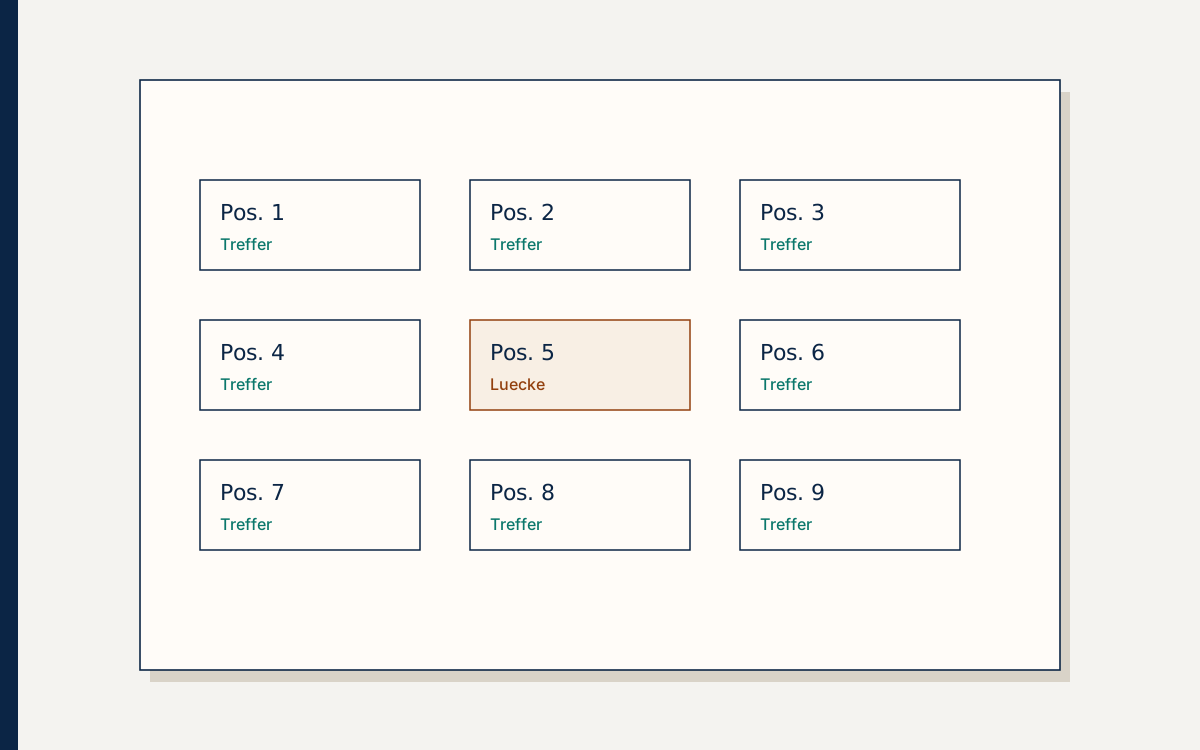
Operation
Mark the gaps in the bill of materials
Missing bill-of-materials lines and unknown numbers stay marked until a person closes them before release.
By Clemens Jonathan Schmid6 min read
Operation
One assembly is enough for the first trial
One sheet, one bill of materials, the serial numbers that belong to it. That shows whether the path holds before the whole family is documented.
By Clemens Jonathan Schmid8 min read
Operation
The assembly becomes visible when you release it
A drawing in the portal is a statement to the customer. The manufacturer makes that statement, not the upload.
By Clemens Jonathan Schmid4 min read