
Operation
What Partmira deliberately leaves with you: price, stock and ERP
Partmira delivers the complete inquiry with the correct part number. Price, stock, booking and release stay with you.
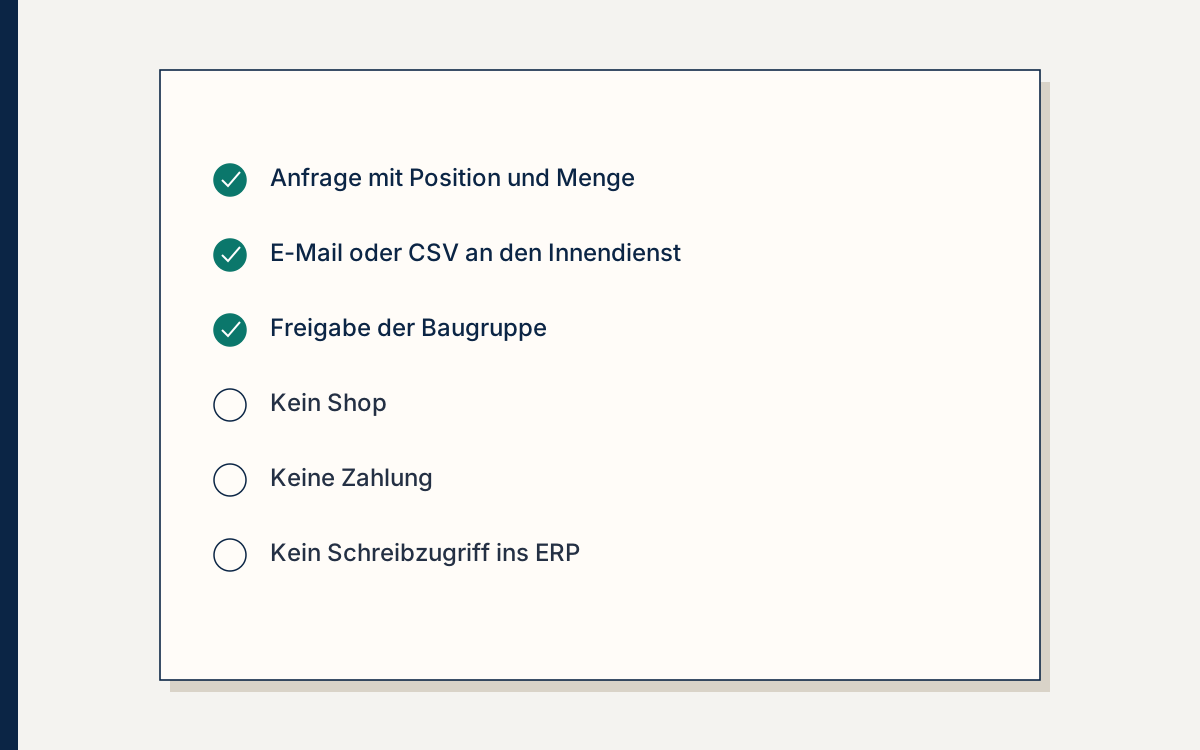
In the first meeting the question usually comes from the side that has a shop in mind. Can the customer pay at once. Can he see whether the part is in the warehouse. Does the portal write the order into the ERP. The answer is no, three times. This is a deliberate division of labour, not forgotten items. For you it means fewer back-and-forths, correct part numbers in every inquiry, built on the exploded views and bills of materials you already have, hosted in Germany. Price, availability, and the decision about what is supplied stay with you. The view makes the line name the part. It does not collect money, and it does not keep stock. You already do both.
Read the limits as a lack and you are looking for another project. Read them as a decision and you can test whether Partmira meets the work that goes wrong today. That work is naming the part. It is not the checkout.
The price comes with the quote, not in a basket
The request the customer sends has no price and no way to pay. It leaves as email or as CSV. Inside sales turns it into a quote. The price stands on that quote. On the drawing, prices are on request. In spare parts the price hangs on the serial, on the quantity, on a minimum batch in production, sometimes on a remainder you hold only once. A number on the sheet would often be a number you then have to explain.
A shop would need that number before the button is pressed. It would take payment, issue a receipt, and need a rule for cancellation. That is another project. Partmira does not take payment. There is no basket and no checkout. The button sends a request. It does not start a delivery. The customer names position and quantity. The quote comes from you, to the address he gave, on the terms you already have with that house. Nobody can later say a price stood on the screen that costing does not know.
No writing into the ERP
The system where your orders arise stays the system where you book. Partmira does not write the ERP. It creates no order line, reserves no bin, and opens no customer you do not yet have. Email or CSV is the handover. A person reads the line and creates the job where your jobs live.
A direct connection would be its own project: fields, permissions, failures, a run someone must watch. It assumes a line that is already right. While the line still comes from a phone sentence, the link would only write that sentence to the wrong place faster. The file is slower and more forgiving. A person can see a serial that does not exist before a document is raised.
The file holds serial, assembly, position, part number, name, and quantity. The quantity is the one the customer set, not the fitted quantity taken quietly from the bill of materials. Customer number, cost object, and bin location are set by the person who takes the file over. Filling those from the drawing would be a second source beside your master data. Partmira does not build that source.
No guessed part number
A position with no bill-of-materials line gets no part number from a similar part, a neighbouring sheet, or a guess that usually hits. The tap writes only what you assigned. If the assignment is missing, the tap is missing, or the gap is visible to you and not yet to the customer. An invented number would look complete. Complete and wrong is the expensive kind, because nobody asks again.
The same holds for the name. A smooth name that only fills an empty field gets taken seriously. The customer compares it with the part in his hand. If it happens to match the neighbour, he taps the wrong line, content. Better a position that cannot be tapped than a name with no hold in the list. The gap belongs to the person who releases.
Superseded numbers are different. The old number stands on the sheet for that serial. The successor is a decision of your house. Both may be visible. Whether you offer the old part, the new one, or both is decided in the quote. A silent swap that drops the old number takes away the number on the customer's machine. Partmira does not guess numbers.
No assembly before your release
The customer sees an assembly when you have released it. An uploaded PDF is a working state. Marks may be in place and the check may show gaps, and the sheet is still absent for him. It becomes visible when someone at your company says: this sheet, these serials, this revision. Without that sentence, a tap has nothing to write into a request. Partmira does not publish before release.
That is awkward when the sheet is nearly done, one position still on the old number, or one serial still pointing at the neighbour. The customer does not separate nearly done from finished. He taps what he sees. Release stays with you. Other stations may be missing, and he calls about those as before. He does not see finished positions mixed with guessed ones.
If an error shows up after release, take the sheet back, correct it, and release it again. The customer should not find that the position was a different part in the morning than in the afternoon. The revision he tapped has to match the line that arrived with you.
No stock figure and no operating manual
Partmira does not say whether a part is there. No traffic light, no stock quantity, no lead time nobody has checked for this serial. Availability is a statement when you quote. Before that it is a guess, and the customer will plan the stop from it. A colour on the screen becomes the mail that quotes the colour.
Prices on request belong with silence about stock. Price and date fall in the quote, not on the balloon. The balloon names the position. If the date is still unknown, say so in the quote, in a sentence a person will stand behind.
The exploded view does not replace the operating manual or the safety notices on the machine. It shows which part a position is. It does not show how the station is made safe, or what residual energy remains. That stays in the manual and in the instruction. Hitting a balloon does not instruct anyone. Partmira supplies no substitute manual.
What you still do yourselves
After the limits, a clear list remains with your people. You set the price in the quote. You say whether the part is available, and when. You judge whether a superseded number is still supplied on this serial, or the successor. You release the assembly, and you take it back when the sheet is no longer right. The portal collects the line. It does not make these judgments.
What goes out is what a description loses: serial, assembly, position, part number, name, quantity. The customer set the quantity. The other fields come from the sheet you released. Ready in four weeks means that cut for one released assembly: marks, the check, the release. Not checkout, booking, the archive, or the manual. Further scope sits in the quote, once you have seen the first sheet. In the demo, with the fictional Muster Maschinenbau GmbH and the VFS 400, nothing is your stock and nothing is your price. The same limits hold when you put a real assembly beside it, one people actually ask for.
By Clemens Jonathan Schmid
Related articles
All articles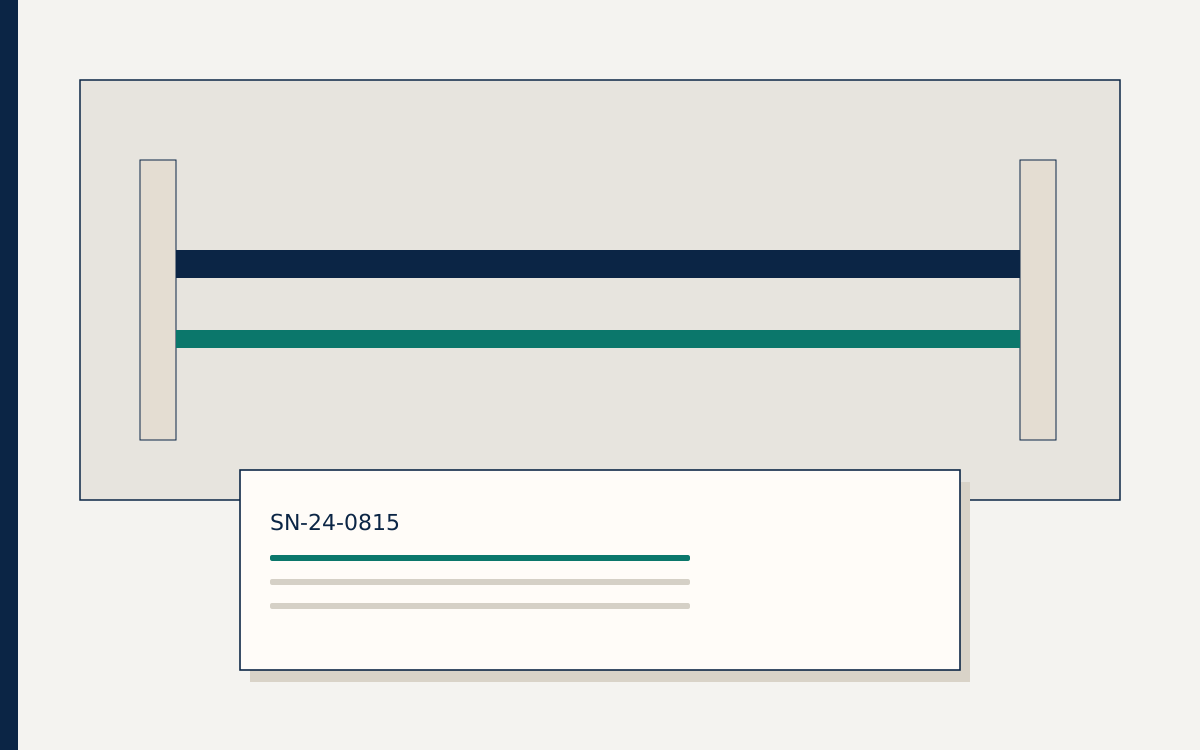
Operation
The fitter is at the machine, not at a desk
The serial number on the nameplate opens the drawing in the short stop, and inside sales writes the quote afterwards.
By Clemens Jonathan Schmid6 min read
Operation
Four weeks to the first released assembly
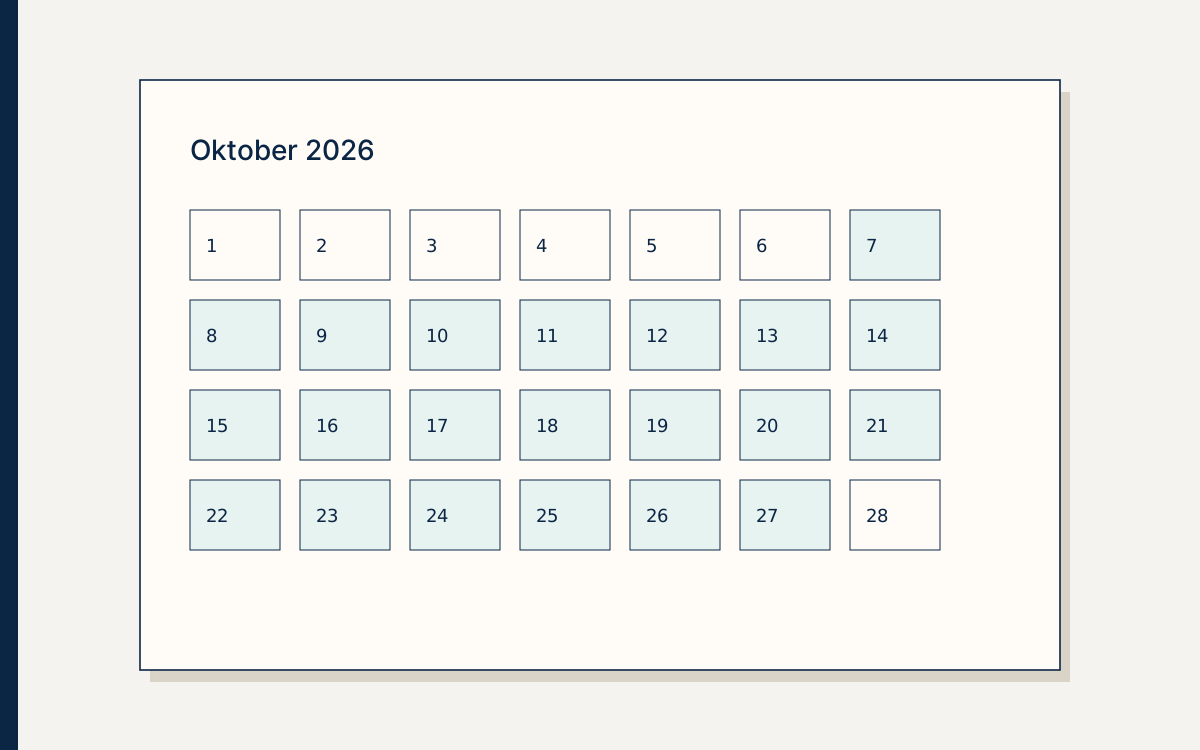
Four weeks means marks, a bill-of-materials check, and the release of one assembly. Not the archive, and not the ERP.
By Clemens Jonathan Schmid4 min read
Operation
The drawing stays with the manufacturer
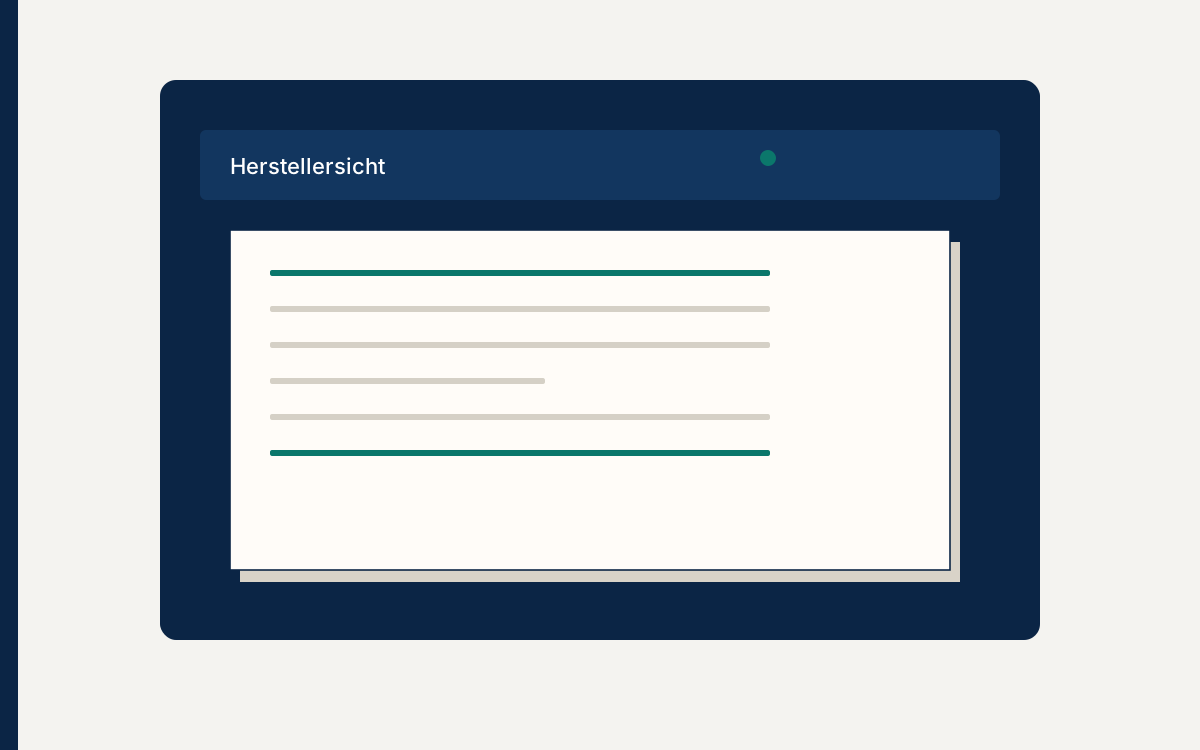
The manufacturer keeps the drawing, the customer sees the released assembly, and hosting in Germany is a plan.
By Clemens Jonathan Schmid8 min read