
Inquiry
What a spare-parts request has to contain
7 min read
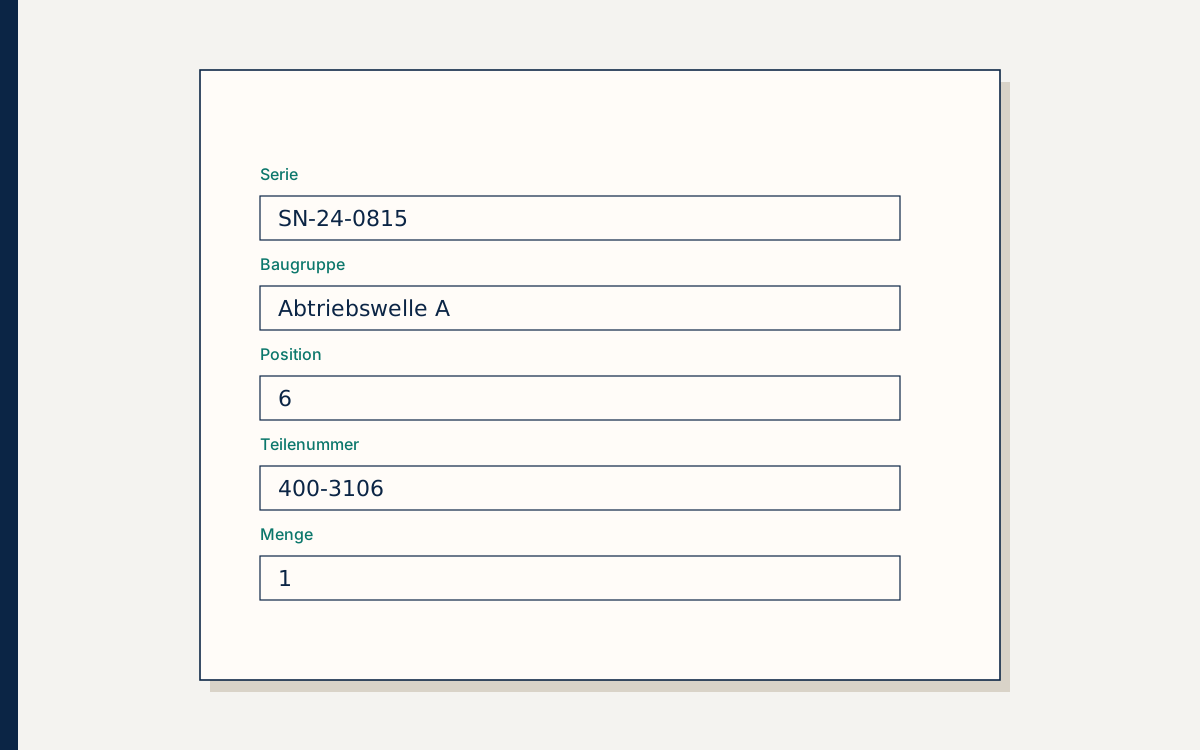
A request is usable when another person can make a job from it without calling back. Not a quote yet, and not a delivery date. A job with the right part. For that there is a short list. It is not original. A large share of the mail still fails it.
What you need is the serial number of the machine, the name of the assembly, the position on the drawing, the part number, the name, and the quantity the customer wants. Without the serial number you do not know which drawing revision applies. Without the position you do not know which line of the bill of materials is meant. Without the quantity you drop in the bill-of-materials quantity and miss. Without the part number, but with position and serial correct, you can look the number up. Without anything but a photo, the work starts again from the beginning.
The quantity is something the customer says
The bill of materials records how the part occurs in the assembly. Two linings, four heater cartridges, one knife. That is the fitted quantity, not the order. The customer changes one lining and leaves the second until the next stop. Treat the bill of materials as an order proposal without asking the quantity, and you create stock at the customer, or a complaint.
The request should therefore carry the quantity as its own number. One is a valid value. The bill of materials stays visible, so the customer can see that two are fitted and decide for himself. That decision belongs to him. It does not belong in a silent default.
What does not belong on the first line
Price and lead time do not stand in the request the customer sends. They stand in the quote you make from it. A portal that invents prices, or offers a basket with a checkout, is promising a shop. A shop is a different business: payment, stock, returns, tax. Many machine builders do not want that for spare parts, at least not as the first step. They want the request, and they want it complete. On the drawing, prices stay on request.
Urgency is not a field that replaces the part number. "Machine down" explains how fast someone should work. It does not explain which part is missing. Both can sit in the same job. Only the second decides what gets picked.
Free text is allowed for what the line does not carry. The shift, the contact person, the wish that the part go to another plant. Free text is a poor place for the part number, because nobody reads it out reliably. What can be held in fields belongs in fields. What is left over may be a sentence.
The superseded number stays readable
If the line contains a part number you have superseded, the request has to live with that. The customer saw the old number on the drawing of his machine, and that drawing is right for his serial. The successor stands beside it, as a note, not as an error message in a warning colour. Whether you offer the old part or the new one is decided in the quote, from the serial and from the stores. The request has done its job when both numbers are named and nobody pretends the old one was a typing mistake.
A request without that clarity produces the familiar loop. You offer the successor. The customer says his drawing shows something else. You explain the serial. He asks whether it fits. Two days, one part. The drawing could already have carried the sentence.
A line the warehouse can read
At the end there is a line: serial, assembly, position, part number, name, quantity. Plus the note, if the number has been superseded. That can be a mail, or a CSV file someone takes into the system you already run. It does not have to be an interface. The interface is its own project, with its own errors. The line is what was missing before.
Judge an incoming request by that, not by its tone. A polite mail without a position is incomplete. A short line with the six items is ready to work. The difference is not courtesy. It is whether someone still has to guess.
Several positions, one job
Rarely is only one part missing. A seal station that has been dragging may need lining and knife, or the fitter changes the cartridge at the same time because the station is already open. The request may have several lines. Each line carries its own position and its own quantity. A collective field called "various wear parts" is a description again.
The order of the lines does not matter. The completeness of each line does. A line with a quantity and no position cannot be rescued because the other lines are right. It stays a question back in the middle of an otherwise usable job. Better not to send the incomplete line at all, and to show the customer what is still missing. That is a small block, and it prevents the mail you would otherwise write.
Who reads the line
Different people read the line. Inside sales checks the serial. Planning or the warehouse looks up the part number. Someone in sales makes the quote. If the line sits only in running text, each of them builds their own copy, and the copies drift apart. A mail with clear fields, or a CSV with one line per position, can be passed on without anyone typing it again.
CSV is not a technical ideal. It is a format that spreadsheets and most business systems can open without a project. The columns should stay stable: serial, assembly, position, part number, name, quantity, and a column for the note about a superseded number. What you later take into your system, you take from these columns. What you do not want to take over, you leave out. A column called "price" in the customer's request would be such a field. You set the price.
The customer does not have to see the columns. He sees the drawing, the position, and a quantity field. The columns come from that. That is the point of the exercise: the structure appears when he taps the drawing, not when someone retypes a mail.