
Spare parts business
The spare-parts inquiry hangs on the drawing
7 min read
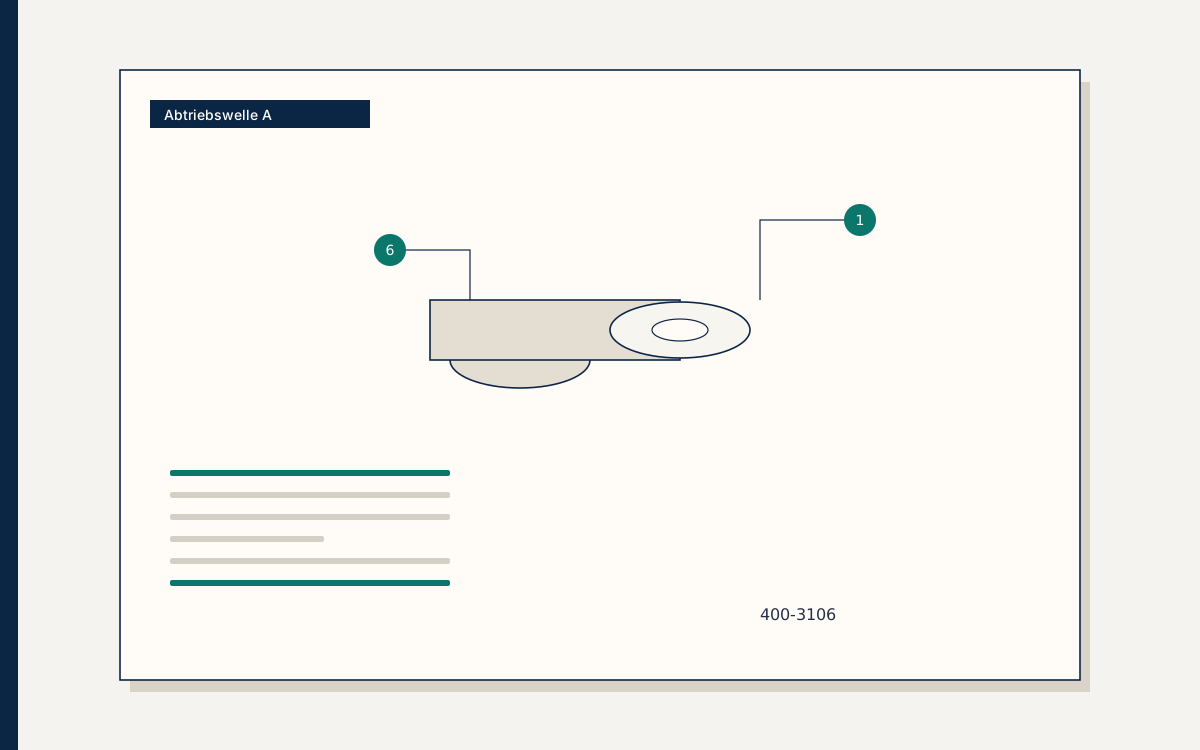
The call comes late in the morning. The machine is down, the shift is waiting, and at the other end someone describes a part they have in front of them. It is the long part above the film. It is warm. It looks like last time, only shorter, or perhaps it is the same part and only dirty. Inside sales writes it down. At the end of the note there is a machine number, an approximate year of manufacture, and three sentences that fit several positions.
That is ordinary life in the spare-parts sales of a machine builder. The inquiry is not wrong. It is incomplete. The caller sees the machine. The clerk sees a file. Between the two lies the drawing, and that is exactly where the information breaks off. As long as nobody points at a position, the inquiry stays a description. Descriptions cannot be picked from the warehouse.
What the description is missing
A usable inquiry names the part the way it stands in the bill of materials. That takes the serial number of the machine, the assembly, the position on the exploded drawing, and the quantity. The part number follows from those. It is the result, not the starting point. People who start with the part number have often taken it from an old delivery note, from an email of three years ago, or from a plate that belongs to another series.
In the conversation this sounds fussy. The machine is down, and someone is supposed to find a drawing first. In practice it runs the other way. Looking up the drawing is the shortest path. Everything else is follow-up questions. Follow-up questions cost the same time, only split across two people, and at the end the wrong part is ordered anyway, because both sides used the same word for two different components. "Strip", "jaw", "knife", and "guide" are not unambiguous names in a packaging machine.
Inside sales knows this. They ask for photos. The photo shows a corner, a hose, a finger held up for scale. Sometimes that is enough for an experienced person. Often it is not, because the photo does not show the back, and the back carries the bore that distinguishes two variants. The drawing shows both views, the position, and the reference into the bill of materials. The photo shows that someone is standing in front of the machine.
The missing piece is not more description. It is a shared place to point. Until that place is named, every extra adjective still fits more than one line in the bill of materials, and the warehouse still cannot pick.
The drawing is the shared object
An exploded drawing is not decoration in the documentation. It is the map on which customer and manufacturer mean the same thing. Every position has a number. The number stands in the bill of materials beside part number, designation, and quantity. Whoever names the number has identified the part, even if they pronounce the designation wrong.
The quality of the inquiry therefore depends on whether the customer can see the drawing of their machine at all. Many companies send the drawing once, as a PDF with the machine, and then never again. The PDF sits in purchasing's folder, not at the control cabinet. The fitter on the line does not have it. They call. Purchasing writes an email and attaches the old PDF without marking the place. Three channels, and no position.
A portal that opens the drawing from the serial number does not turn the channel into something magical. It puts the drawing at the place where the inquiry starts: in front of the machine, on the phone, with the number from the nameplate. The tap on the position is the sentence the phone call does not reliably deliver. After that, the inquiry contains something a warehouse understands.
The fitter does not have to become a reader of drawings. They have to be able to reach the sheet that belongs to the plate on this machine, and to point at one position on it. Purchasing can still send the email. The difference is that the email now names a position instead of forwarding an unmarked PDF.
What inside sales still has to decide
Even a clean position does not spare you the quotation. Availability, price, lead time, and the question of whether the part is still fitted in this series stay with the manufacturer. A superseded part number has to be recognizable as such. The old number must not disappear, or the customer searches into empty space and orders the copy. The note on which part has taken its place belongs on the drawing, not in a footnote only the designer knows.
The quantity stays a statement by the customer, too, not an automatic reading of the bill of materials. The bill of materials says how many pieces are fitted in the assembly. The customer may need one of them. Take the bill-of-materials quantity silently as the order quantity, and you ship three parts, of which two go onto a shelf or come back. The inquiry should name the quantity wanted. The bill of materials explains why that quantity exists in the machine.
Gaps stay gaps. If a position is missing on the drawing, or a line is missing in the bill of materials, it does not help to invent a number so the screen looks complete. The gap has to be visible, so that a person closes it before the customer sees it. A released assembly is an assembly for which the manufacturer has done that check. Everything else is a draft.
The commercial effect is dull, and that is why it is usable
This is not about a percentage nobody has measured. It is about a concrete case: fewer follow-up questions, fewer wrong parts, fewer situations in which the customer buys elsewhere because they could not name the part with you. After-sales revenue arises at the right part, sent out once. Every loop before that is work without an invoice, or worse, an invoice followed by a credit note.
The drawing is the tool you already have for this. It sits in the CAD system, in the PDF, in the folder for the machine. Unused, it is an archive. Used at the moment of the inquiry, it is the ordering path. The customer does not have to read it the way a designer does. They have to be able to tap a number that belongs to their serial number.
Anyone who wants to set this up for a whole product family at once waits for complete data that rarely exists in that form. For the first step, one assembly is enough: one on which you can see where the drawing holds and where the bill of materials has gaps. The scope after that is a question for the quotation, not a promise on the start page.