
Documentation
The exploded view is the ordering path
5 min read
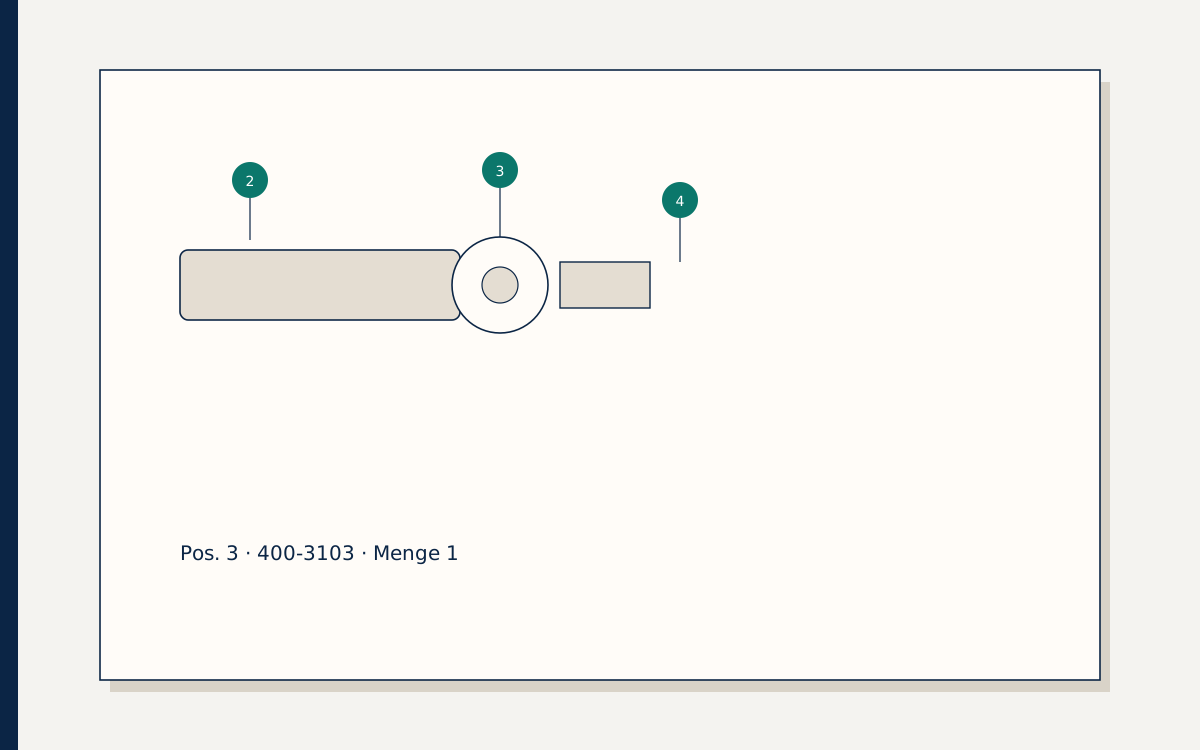
In design, the exploded view is one sheet among many. It shows how the assembly comes apart, so that someone can put it together and maintain it. In spare-parts sales the same sheet is something else. It is the path on which a customer orders a part without knowing the internal name. For that, the drawing has to work like a map, not like a reminder of the design.
A map has fixed places. Every part that should be orderable has a position. The position is a number in a circle, the balloon. A line joins the balloon to the part. The line must not tangle with the others, or it points at two things, or at none. That sounds like a drafting rule. It is an ordering rule. Anyone who does not trust the line calls and describes the part in words again.
What has to be on the sheet
The number in the balloon is not a part number. It applies only on this sheet, in this assembly, at this revision. Beside it, the bill of materials gives the part number for that balloon, the name of the part, and how many pieces sit in the assembly. Without the bill of materials, the drawing is a picture. Without the drawing, the bill of materials is a list with no place. Together they are the catalogue.
Not every screw needs its own balloon if it is not ordered on its own. The part service replaces does need one. Sealing bar, facing, knife, counter bearing, cylinder, guide rod, bearing, limit switch, cover: on a sealing station those are not decoration. They are the parts people ask for. A drawing that turns them into rectangles and lays twelve lines criss-cross over the sheet looks like a drawing and does not work like one.
Line weights help the eye. The outer edge is thicker than the bore, hatching shows a cut face, and the shaft has a centre line. That is not aesthetics for its own sake. A fitter recognises from it what is a bearing and what is a screw. A flat surface with no hatching and no difference between shaft and housing forces a guess. Guessing is the start of the wrong part number.
The balloon sits on a grid
Balloons scattered freely on the sheet look lively and are hard to hit. On a phone the fingers are wide. Two balloons that sit too close cannot be tapped one by one. A grid at the edges, left and right, with even spacing, solves that. The line runs horizontally from the part to the balloon. Horizontal lines at different heights do not cross.
The grid is also a check. If twelve positions do not fit on two columns without touching, the drawing is too full, or the assembly is too large for one sheet. Then you split, instead of making the numbers smaller. A position you cannot hit is not a position.
The same drawing applies to the demo and to later operation. The coordinates of the balloons are the coordinates of the request. If someone shifts the graphic and forgets the numbers, the tap lands on the neighbouring part. That is why the drawing and the positions are versioned together, not as a picture in one place and a table in another that nobody matches any more.
From the sheet to a line in the request
The customer opens the drawing of their machine, taps the position, and enters the quantity. The line that arrives contains the position, the part number, the name, and the quantity. That is less charming than a good phone call, and more useful to the stores. The conversation remains for everything the drawing does not know: the urgency, the address, the wish for an alternative part, the question of whether the machine is still under an agreement.
The drawing answers only the question of which part is meant. That is the question on which most requests fail. Once it is answered, the real work starts, and it starts in the right place.
Anyone who keeps the exploded view only as an annex to the instructions for use, and never as a place to order from, keeps it for acceptance and not for the ten years after. In those ten years the wear part is ordered more often than the machine was sold. The sheet that helps is the same one. It only has to lie where the finger is, and the line has to arrive at the part.
The bill of materials and the sheet stay a pair
A new revision of the drawing without a new bill of materials is half a revision. The balloons point at numbers that no longer appear in the list, or the list names parts that have no position on the sheet. Both are a gap, and both gaps look the same in operation: the customer taps, and no unambiguous line comes back. The match belongs to release, not to next quarter.
Changes against the previous sheet should be named. A position that is new, one that has gone, a number that is on the sheet and missing from the list. Those are not the customer's errors. They are findings from your documents. Anyone who sees them before release corrects them. Anyone who sees them only in the request corrects them under time pressure, while the machine is down.
The name in the bill of materials should sound like the workshop. "Upper sealing bar" is more useful than an internal short code that only production planning knows. The code can sit beside the name. It cannot replace it. The customer reads the name to make sure they hit the right position. If the word does not match the part in their hand, they stop and call. Then the balloon was wasted.
A sheet you can hit on the phone
Most requests do not start at the purchasing desk. They start at the machine, with the phone in one hand and the stop in the other. The sheet has to be readable there. Balloons that overlap, type that becomes a bar when it is reduced, lines that run across the part and hide the shape: those are reasons to put the phone down and pick up the receiver.
A clean drawing saves that reach for the phone. It does not have to be pretty the way a brochure is pretty. It has to be unambiguous. Unambiguous means one number, one part, one request line, and a quantity the customer sets. Quote and dispatch stay with you. The drawing has then done its share of the work, in the place where the spoken description used to stand.